
Buy America & AIS Compliance for MBR Wastewater Systems: A Specifier’s Checklist
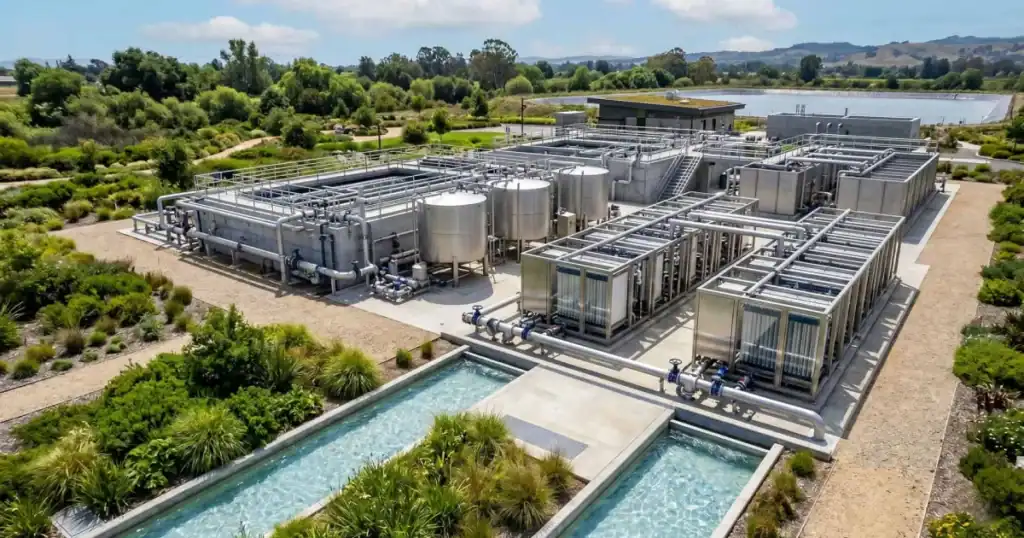
If your project draws on Clean Water or Drinking Water State Revolving Fund money, every iron and steel product installed in it must be produced in the United States. This is not a temporary condition of a particular funding round — it is a permanent requirement for CWSRF, DWSRF and WIFIA projects. For a membrane bioreactor, the component most likely to fail that test is the membrane itself.
Most compliance problems on MBR wastewater treatment plants are not discovered at bid. They are discovered at submittal review, when a manufacturer cannot produce a certification letter for a valve body, a membrane frame or a blower skid — and by then the schedule is already committed. This checklist is written for the engineer who has to specify the system, not for the attorney who has to defend it afterward.
AIS vs. BABA: what actually applies to your project
Two domestic preference regimes can apply to the same wastewater project, and they are not the same rule.
American Iron and Steel (AIS) is the older and narrower of the two. It requires that iron and steel products used in a CWSRF- or DWSRF-assisted project for a treatment works or public water system be produced in the United States. The Infrastructure Investment and Jobs Act made AIS permanent across CWSRF, DWSRF and WIFIA.
Build America, Buy America (BABA) is broader. It reaches three categories of material rather than one: iron and steel products, manufactured products, and construction materials. It applies to federal financial assistance for infrastructure generally.
The two overlap, and EPA has been explicit about how: compliance with AIS satisfies the BABA iron and steel requirement. State programs generally treat it the same way — if you meet BABA, AIS is met as well, and there is no need to duplicate manufacturer certifications or de minimis lists for both.
| AIS | BABA | |
|---|---|---|
| Covers | Iron and steel products | Iron and steel products, manufactured products, construction materials |
| Applies to | CWSRF / DWSRF / WIFIA assisted projects | Federal financial assistance for infrastructure |
| Status | Permanent (IIJA) | Permanent (IIJA) |
| Relationship | Satisfied when BABA is met | Its iron and steel requirement is satisfied by AIS compliance |
Which one governs depends on how the state agency classified the funds. Projects funded with federal equivalency funds must meet BABA, which in turn satisfies AIS; projects funded with non-equivalency federal recycled funds need only meet AIS. Confirm this with your state program before writing the specification — on a municipal wastewater treatment project, it changes what you have to certify.
The three standards, stated plainly
- Iron and steel products
All manufacturing processes, from the initial melting stage through the application of any coating, must take place in the United States. A domestically fabricated part made from imported billet does not comply. Neither does a domestically produced part that was galvanized abroad. - Manufactured products
The product must be manufactured in the United States, and the cost of the components mined, produced or manufactured in the United States must exceed 55 percent of the total cost of all components. The threshold is calculated on component cost, not on the selling price and not on weight. - Construction materials
All manufacturing processes associated with the material must have occurred in the United States. Covered examples include non-ferrous metals, PVC, composite building materials and lumber. Cement, aggregates such as stone, sand and gravel, binding agents, and non-permanent items are excluded from this category.
Which parts of an MBR system fall into which bucket
This is where MBR projects get complicated. A packaged MBR train is not one product; it is dozens of products in three different regulatory categories, assembled on a skid.
| Category | Typical MBR components |
|---|---|
| Iron and steel products | Steel tanks and tank plate, structural steel, walkways, grating and handrail, anchor bolts and fasteners, steel pipe and fittings, valve and pump castings, hangers and supports, manhole frames and covers |
| Manufactured products | Membrane modules and racks, blowers, pump assemblies, fine and coarse screens, screw presses, UV disinfection units, control panels and SCADA cabinets, skid-mounted packaged trains |
| Construction materials | PVC and HDPE piping, non-ferrous metal components, FRP and composite elements, fiber optic and certain cabling |
The gray zone is the skid. A membrane module is a manufactured product, but its steel frame is an iron and steel product. Depending on how the state agency evaluates it, a packaged train may be treated as a single manufactured product subject to the 55 percent test, or broken apart so that each iron and steel component is certified individually. That determination changes the entire submittal package, so raise it with the agency during design — not after award. The same question applies to treatment plant equipment procured as standalone upgrades.
The specifier’s checklist
Ten items to resolve before the specification goes out for bid.
- Confirm the funding classification. Equivalency or non-equivalency. This determines whether BABA or AIS alone governs.
- Put the requirement in the technical sections, not only in the front end. Boilerplate in Division 00 does not stop a supplier from quoting an imported membrane in Division 46.
- Require a signed certification letter for every covered product. On manufacturer letterhead, naming the project, describing the product, and stating that all manufacturing processes occurred in the United States.
- Require step certifications for multi-stage products. Melting, forming, finishing and coating may occur at different facilities. Each step needs to be covered.
- Ask where the membrane sheet is made — not where the module is assembled. Assembling an imported membrane sheet into a domestic frame does not make the module domestic. This is the single most common gap on MBR projects.
- For manufactured products, request the component cost breakdown. You cannot verify a 55 percent threshold without the underlying component costs. Ask for it at submittal, not at closeout.
- Scrutinize the small items. Valves, fittings, fasteners, couplings, flanges, restraints and saddles are where AIS findings usually originate — not on the tanks.
- Build the de minimis list early. Miscellaneous incidental items may be covered under a de minimis waiver when they total no more than five percent of the total project cost. Track them from the start so the cap is not exceeded by accident.
- Check lead times against the construction schedule. A waiver is not a procurement strategy. Confirm domestic availability and delivery before a non-availability waiver becomes your only option.
- Retain every certification through audit. The documentation obligation does not end at substantial completion.
Documentation to demand from a supplier
- A certification letter per product, on manufacturer letterhead, identifying the project by name
- A statement that all manufacturing processes occurred in the United States, with the signer’s name, title and date
- Step certifications from each facility involved in a multi-stage process
- A component cost worksheet supporting the 55 percent calculation for each manufactured product
- A de minimis worksheet tracking incidental items against the five percent project cost cap
- Mill certifications or country-of-melt documentation where the agency requires them
A supplier who cannot produce these on request during bidding will not produce them during construction either.
Waivers, and what they cost you
Waivers exist, and they are legitimate. They are also slow, public, and visible to everyone reviewing the project.
| Waiver type | When it applies |
|---|---|
| Public interest | Applying the domestic preference would be inconsistent with the public interest |
| Non-availability | The material is not produced in the United States in sufficient and reasonably available quantities of satisfactory quality |
| Unreasonable cost | Domestic sourcing would increase the cost of the overall project by more than 25 percent |
| De minimis (general applicability) | Miscellaneous incidental products totaling no more than 5 percent of total project cost |
| Minor components (national) | Small components within a larger iron or steel product, subject to the national waiver terms |
One trap worth naming: the SRF Design Planning Adjustment Period Waiver, which exists to ease the transition into BABA, does not waive the iron and steel requirements. AIS still applies underneath it.
Why the membrane is the hardest component to source domestically
Tanks can be fabricated domestically. Pumps, blowers, screens and control panels have well-established domestic suppliers with certification letters already on file. The membrane is different. The global flat-sheet and hollow-fiber MBR membrane supply is concentrated in Asia and Europe, which means that on a federally funded project the membrane is frequently the component that forces a waiver conversation — or a change of technology.
A3-USA manufactures its MaxFlow™ ultrafiltration membrane modules in Jacksonville, North Carolina, and builds its skid-mounted and containerized MBR trains in the same facility. For projects where domestic sourcing is a condition of funding rather than a preference, that matters at the specification stage, not at the submittal stage. More on domestic manufacturing and documentation: American-made MBR membranes and systems.
If you are evaluating whether an existing plant can be upgraded within these constraints, a wastewater treatment plant evaluation is the right starting point — it establishes which components actually have to be replaced before the compliance analysis has anything to act on. And if you are still deciding between technologies, the MBR wastewater treatment process explains where a membrane bioreactor fits relative to SBR and conventional activated sludge.
Frequently Asked Questions
Is the American Iron and Steel requirement permanent?
Yes. The Infrastructure Investment and Jobs Act made the AIS provision a permanent requirement for CWSRF, DWSRF and WIFIA projects. It is not tied to a single appropriation year.
Does BABA replace AIS on SRF projects?
No. They coexist. BABA is broader, covering manufactured products and construction materials in addition to iron and steel. Compliance with AIS satisfies the BABA iron and steel requirement, so the certifications do not need to be duplicated.
What is the domestic content threshold for manufactured products under BABA?
The product must be manufactured in the United States and the cost of components mined, produced or manufactured in the United States must exceed 55 percent of the total cost of all components.
Are MBR membranes covered by AIS or by BABA?
A membrane module is generally evaluated as a manufactured product under BABA, while its steel frame and the surrounding tankage, piping and supports are iron and steel products under AIS. Confirm the classification with your state SRF program during design.
Does assembling an imported membrane in the United States make it compliant?
Not by itself. For iron and steel products, all manufacturing processes from initial melting through coating must occur in the United States. For manufactured products, final assembly in the United States is necessary but not sufficient — the 55 percent component cost threshold still applies.
What happens if a compliant domestic product is not available?
A non-availability waiver may be requested. Waivers require justification and a public comment period, so they carry schedule risk and should be identified during design rather than during construction.
Specifying an MBR system on an SRF-funded project? A3-USA manufactures MaxFlow™ membranes and packaged MBR systems in North Carolina and can provide certification documentation for review during design. Request the documentation pack.
This article is general information for design professionals, not legal advice. Domestic preference determinations are made by the funding agency. Confirm requirements with your state SRF program before relying on any interpretation here.