
Screw Press, Belt Filter Press or Centrifuge? Choosing a Sludge Dewatering Technology
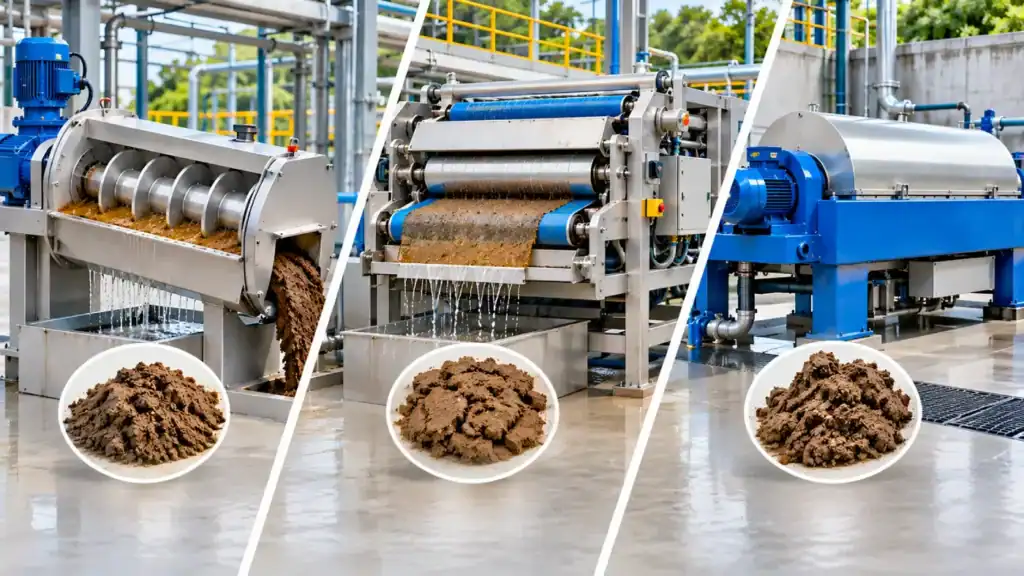
Screw press dewatering uses a slowly rotating auger inside a stationary wedge wire screen to squeeze water out of conditioned sludge. It is one of three technologies that dominate municipal and industrial dewatering, alongside the belt filter press and the centrifuge — and the right answer depends far more on your plant than on the machine.
This article covers how a screw press works, how the three compare, and the variables that actually decide between them. If you already know a screw press is what you need, our sludge dewatering page has the model data.
What screw press dewatering actually does
The mechanism is simple, which is most of its appeal. Conditioned sludge is pumped into one end of a cylindrical wedge wire screen. Inside it, an auger with a tapered shaft turns slowly, conveying the sludge along the screen while the narrowing geometry compresses it. Water passes through the wedge wire as filtrate. Cake discharges at the far end, against an adjustable restriction that sets how hard the sludge is squeezed.
Because the auger turns slowly and the housing is enclosed, a screw press tends to run quietly, with modest power draw and little aerosol or odour escape. Screen blinding is the failure mode to design against, which is why presses run continuous cleaning — spray nozzles, brushes on the auger flights, or both.
Screw press, belt filter press, centrifuge
Generalisations here are exactly that. Every one of these varies by manufacturer, sludge and conditioning.
| Screw press | Belt filter press | Centrifuge | |
|---|---|---|---|
| Power draw | Low | Low to moderate | High |
| Operator attention | Low — commonly automated | Moderate — belt tracking and washing | Moderate — high-speed machine |
| Wash water | Low | High | Minimal |
| Cake solids | Moderate | Moderate | Highest of the three |
| Footprint | Compact, but long | Largest | Smallest per unit throughput |
| Noise and odour | Enclosed, quiet | Open, wet, more odour | Noisy, enclosed |
| Typical fit | Small to mid plants, limited staffing | Mid to large, continuous duty | Large plants, high flow, 24/7 |
Notice what the table does not give: exact cake solids percentages for each technology. Those numbers only mean something against a specific sludge, and comparing a vendor’s best-case figure on primary sludge with another’s on waste activated sludge is how plants end up disappointed.
The variables that actually decide it
- Sludge type. Primary dewaters more readily than waste activated sludge.
A mixed sludge behaves like neither, and an industrial sludge may behave like nothing in the
textbook. - Flow and operating hours. A machine sized to run eight hours a day is a
different machine from one running continuously. - Operator availability. This decides more projects than any technical factor.
A plant with one operator covering several sites needs equipment that does not ask for
attention. - Polymer cost over the life of the plant. Capital cost is visible at
procurement; polymer is visible every month afterwards. - What happens to the cake. Disposal priced by the ton rewards every extra
point of dryness. Disposal priced by the load may not. - Footprint and headroom. Screw presses are compact but long, and they need
clearance to pull the auger for service.
Conditioning is not a detail
No dewatering machine performs without properly conditioned sludge. Polymer type and dose have to be established by jar testing on your own sludge and confirmed in service, and they shift as the plant’s biology shifts through the year.
Treat any polymer dose quoted to you without reference to your sludge as a placeholder. It is the single most common source of the gap between quoted performance and delivered performance.
Where the cake goes matters too
Dewatering is not the end of the sludge train. Whether the cake is land applied, landfilled or further processed sets the dryness you actually need and the record keeping that comes with it — see the EPA’s basic information about sewage sludge and biosolids. Specifying for a cake solids target without knowing the disposal route is specifying blind.
Comparing quotes without being misled
Ask every vendor for the same things:
- Performance quoted against your sludge characterisation, not a reference sludge
- Feed solids and target cake solids stated explicitly
- Polymer type and expected dose, with the basis for the estimate
- Installed power and expected operating hours
- Wash water volume and whether it returns to the head of the plant
- Footprint including service clearance, not just the machine envelope
- What the operator has to do daily, weekly and annually
Quotes built on different assumptions are not comparable, and the cheapest machine on capital is frequently the most expensive one to run.
Where A3 fits
A3-USA supplies the A3 Screw Press, which dewaters municipal and industrial sludge in the 0.6 to 5% solids range to an 18 to 25% cake, in five models covering 2 to 100 gpm. It is supplied alongside the rest of the treatment plant equipment a sludge train needs.
On an existing plant, a treatment plant evaluation establishes what the sludge stream actually looks like before anyone specifies equipment against it.
Frequently asked questions
How does screw press dewatering work?
An auger with a tapered shaft rotates slowly inside a cylindrical wedge wire screen. Conditioned sludge enters at one end, the auger conveys and compresses it against the screen, filtrate passes through the wedge wire, and cake discharges at the far end against an adjustable restriction.
Is a screw press better than a belt filter press?
Not universally. A screw press generally runs with less operator attention, less wash water and lower power, in an enclosed housing. A belt filter press typically offers higher throughput per unit of capital on larger duties. Which wins depends on flow, operating hours and how much operator time the plant has.
When is a centrifuge the right choice?
Centrifuges generally reach the highest cake solids and handle large, continuous flows in a small footprint. They draw substantially more power, run at high speed with the maintenance that implies, and are noisier. On large plants running around the clock those trade-offs often make sense; on small plants they rarely do.
How much polymer does dewatering need?
It depends on the sludge, not on the machine. Polymer type and dose have to be established by jar testing and confirmed on site. Treat any dose quoted without reference to your own sludge as a placeholder.
What cake solids should I expect?
It depends on sludge type, conditioning and the machine. Primary sludge dewaters more readily than waste activated sludge, and a mixed sludge sits between them. A3 publishes 18 to 25% cake solids for its screw press on feed in the 0.6 to 5% range.
Can a screw press run unattended?
Screw presses are commonly specified for automated operation, which is part of why they suit smaller plants with limited staffing. Supervision still matters, but the machine is not designed to need an operator standing at it.
How do I compare quotes from different vendors?
Insist that every vendor quotes against the same sludge characterisation, the same feed solids and the same target cake. Without that, the numbers are not comparable, and the lowest capital cost usually hides the highest polymer bill.
Sizing a dewatering system? Send your sludge flow, feed solids and target cake and A3-USA will tell you which model fits — or whether a screw press is the right technology at all. Talk to an engineer.